Thursday, March 5, 2015

What Trickle-Down Economics Has Done to the U.S.

Reprinted from www.Truth-out.org

What Trickle-Down Economics Has Done to the US: The Rich Get All the Money

Thursday, 05 March 2015 10:44By Dan Riker, Truthout | News Analysis
A protester throws a chair at the Occupy Oakland "Move-In Day" demonstration. (Photo: Glenn Halog)A protester throws a chair during the Occupy Oakland "Move-In Day" demonstration. (Photo:Glenn Halog)
Adapted from the as-yet-unpublished book by the author, Do What Works and Call It Capitalism.
That Improving Economy Is Further Away Than It Appears
Leisure and hospitality - the fastest growing major blue-skill industry - is the worst sector. The average leisure and hospitality worker makes just $18,900 a year (gross, before taxes). This is not even enough to keep a family of three above the poverty level ($19,790 in 2014). Similarly, retail, the largest blue-skill sector, is second-worst in terms of pay, with average annual earnings of $27,700. - Mike Cassidy, Where Are the Jobs? 2015 (1)
By most media accounts, the US economy at the beginning of 2015 is recovering nicely from the Great Recession. GDP is growing at a historically healthy rate, above 2 percent per year. Unemployment is about the historic average, at 5.7 percent. The stock market is near record highs. And more jobs are being created than at any time in more than 10 years. But this is all a great deception. The expansion is benefiting a tiny minority of the population only - the very rich. No one else has any money, and without significant changes in government policies, no one except the wealthy is likely to have any in the future.
This is the fact that eluded the Democrats in the 2014 election. When Democrats boast of how well President Obama has done with the economy despite Republican opposition to everything he does, they are missing the point. This economic resurgence has not reached most Americans.
Ronald Reagan brought supply-side economics to the federal government, the belief that suppliers of goods drive the economy, not the consumers. The supply-siders believe that lower taxes stimulate production and improve the economy. They also favor deregulation of industry. The theory, which acquired the nickname "trickle-down economics," was that economic growth would benefit everyone. That has not happened. The entire supply-side economic theory has proven to be totally wrong as the data in this article shows.
When George H.W. Bush ran against Reagan for the Republican nomination in 1980, he called Reagan's supply-side economics, "voodoo economics," and he was right. It has no basis in reality, but it has bewitched the Republican Party and they still cling to it. And most current government financial policies still are consistent with it. Bill Clinton did not change things. Barack Obama has not changed things. The Reagan economic program still is with us, and still is doing great damage to the US economy and most Americans.
At the beginning of 2015, more than six years since the crisis of 2008, most Americans were either in a worse financial condition than they were before 2008, or had experienced very little improvement in their economic condition. Most Americans have no financial reserves and live paycheck to paycheck.
In January 2015, the Pew Charitable Trusts published "The Precarious State of Family Balance Sheets," in which the incredible conclusion is reached that virtually no one in the United States has ready cash reserves to cover two months of lost income. Clearly, most of the top 20 percent have other assets, stocks and bonds, real estate etc. on which they can draw, and they seldom lose their jobs without good severance packages. But 80 percent do not have enough reserves to last more than a month, and half of them do not have enough to last two weeks.
Most Americans also do not have much in the way of assets - property or investments. The historic recovery of the stock market from the 2008 crash did not benefit the vast majority of Americans because they don't own stock. Yes, many do indirectly through 401k mutual funds and pension funds, but those assets cannot easily be converted into cash.
Between the burst of the housing bubble and the huge trade deficit, a trillion dollars has disappeared from the US economy and Americans are not spending enough to make it up.
A substantial portion of the loss of $8 trillion in home equity in the subprime mortgage meltdown has not been recovered, especially for those in less expensive homes, and for the millions forced out of their homes, their losses will never be recovered. The rapid rise in home values in the years prior to the 2008 meltdown was a giant real estate bubble larger than any in the past. People borrowed against their rising home equity, or refinanced and took cash out of their homes. That "bubble economy" generated hundreds of billions of dollars in annual economic activity. When the bubble burst and those home values dropped, those hundreds of billions of dollars vanished from the economy. And they have not been replaced.
At the same time, rising imports and a strong dollar caused a massive trade deficit of $505 billion in 2014. When the US dollar rises in value against other currencies, it makes US products more expensive and imports more competitive. It also reduces the overseas profits of US companies when those profits are converted into dollars.
Compare the loss of approximately $1 trillion in consumer spending annually with the one-time expense of the 2009 Obama stimulus package of $819 billion and it is not hard to see why the recovery from the Great Recession has been so slow, and has reached so few of the people.
The following chart shows the growth in actual dollars of household consumer spending in the United States between 1990 and 2013. There was a steady increase through the 1990s and the total spending increased by $10,000, or 33 percent. In the next five years, when the housing bubble was growing, it increased twice as fast, rising by another $10,000. Then the crash of 2008 occurred and spending dropped. By 2012, consumer spending had returned to the level of 2008, but it dropped slightly in 2013. Consumer household expenditures in 2013 were only about 5 percent higher than they were in 2008.
Average Annual Household Expendatures.Average Annual Household Expendatures
There is no recovery of middle class jobs.
And then, to top things off, most of the jobs that have been created since the end of the Great Recession are at the upper levels, where significant education and/or skills are required, or at the lower levels, where the average wages are declining and are at or close to poverty levels. The kinds of good-paying factory jobs that once provided people without college educations a chance at a middle-class life are a small fraction of the jobs being created today.
Many of the people who lost jobs that supported their middle-class lifestyles are now working for much lower wages in service jobs and living in, or close to, poverty. A Federal Reserve study reported that the greatest demand for workers since the Great Recession has been in the poverty-level, minimum wage-paying service industries, and the lowest demand is for midlevel workers who once comprised the vast majority of the middle class. (2)
An April 2014 report (3) by the National Employment Law Project provided details supporting the Federal Reserve study. During the recession, low-wage jobs, those paying less than $27,700 per year, had both the lowest percentage of losses and the highest percentage of gains. Twenty-two percent of the total job losses were in the low-wage category, but 44 percent of new jobs were in that category. Mid-wage jobs, those paying between $27,700 and $41,600, had the lowest percentage of new jobs created, 26 percent, but the second highest rate of job losses, 37 percent. High-wage jobs, those paying more than $41,600, had the highest rate of losses, 41 percent, but a higher rate of new jobs created, 30 percent, than the mid-wage category.
In January 2015, The Century Foundation report, "Where Are the Jobs?," reinforced those earlier studies. This chart shows the growth of jobs and in each classification indicates the percentage that requires a college education.
2015 0305richchart-2
Of the 257,000 jobs in the January 2015 report of jobs created, 22,000 were in manufacturing, but the average for the three previous months was 31,000, still not a great deal. And the total of manufacturing jobs today is only about 10 percent of all jobs.
The most jobs created in any category were in retail, 45,900, the second-lowest paying of all job categories with an average wage of $27,000. Health care and construction each created about 39,000 jobs. The growth of construction jobs is good news for blue-collar people because generally jobs do not require a college degree and the jobs pay well, on average about $54,000. Health-care jobs are mixed between some that require college and some that do not. While health care is a rapidly growing field, wages are not particularly high except for professionals and those with advanced training.
Here are the average wages by job category:
2015 0305richchart-3
Only about 20 percent of people with jobs are experiencing increases in income.
Even if you were lucky enough to have a good-paying job in 2015, you probably were getting little in the way of pay increases unless you were promoted. Average wages have risen only slightly in recent years, about 2 percent per year in 2013 and 2014, and less than that previously.
2015 0305richchart-4
Among households, the only group that has increased its share of national income since 1980 is the top 20 percent. Every other group has experienced a gradual decline. And it can be seen from the following chart that in recent years there has been an acceleration of the increases in the earnings of the top 20 percent. There definitely was a change in income distribution beginning in 1980 when Reagan was elected. Prior to that, as can be seen in the row 1970-1980, the bottom 20 percent received the highest percentage gain in income. Since 1980, the bottom 20 percent have received the lowest percentage increase in income. Under President Obama, they have done particularly poorly, with their average income declining slightly. The chart also shows how much better the top 20 percent have done since 1980 compared to everyone else.
2015 0305richChart-5
Wages of lower-paid occupations are getting even lower while wages of higher-paid occupations are rising. The Century Foundation reports:
The rich are getting richer. For every $10,000 in additional average weekly earnings an industry had in 2007, its average earnings grew by an extra 2 percentage points during the six-year period. For example, the average employee working in retail, a low-paying industry, earned $28,300 for a full year of work in 2007; after adjusting for inflation, the same employee actually made less, just $27,700, last year. By contrast, the average information worker earned $59,900 in 2007, among the highest of any industry. During the next six years, the advantage of information workers over poorly paid workers only grew, with average earnings increasing 9.4 percent, or $5,600 in real terms. The same is true of other white-collar sectors, like finance (a gain of $4,500) and professional services (a gain of $3,600). Like so many other labor market indicators, this link between earnings and earnings growth reflects rising inequality. (4)
A recent report shows that even the wages of factory workers are declining. And the result of declining wages is increasing poverty. Of the 34 countries in the Organization for Economic Cooperation and Development (OECD), which includes most of the countries in Europe, North and South America, Australia, New Zealand, Japan and South Korea, there are only four that have a higher percentage of their population in poverty than the United States: Chile, Mexico, Turkey and Israel.
2015 0305richchart-6
This graph compares the percentage of each country's population that is living below the poverty line against the percentage of the GDP each country dedicates to public sector social spending. The countries included are all of the members of the OECD.
France (which spends the largest percentage of its GDP on its safety net), Mexico (which spends the smallest percentage) and the United States are specifically marked. The US spends a low percentage of its GDP on its safety net and has a very high percentage of its population living in poverty. (5)
Economic inequality and increasing poverty are direct results of government policies.
There have been a number of policy decisions by the federal government that have had a negative effect on the economy and on average income, resulting in less money being available for consumption, and also increasing poverty. With less money available for consumption, fewer goods are purchased, and fewer jobs are created. And cheaper foreign goods sold by the discount chains have greater appeal.
One of the decisions has been not to increase the minimum wage, nor to index it to inflation. As a result, it has not kept up with inflation, and it has not kept up with productivity. It would be almost $11 an hour now if it had just kept up with inflation. Various calculations have placed between it between $18 and $22 an hour if it had kept up with productivity. While there are only a few million people working at the minimum wage, there are many millions more working at wages not much higher than the minimum. An increase in the minimum wage would push up the income of tens of millions of Americans.
Another decision has been to limit unemployment benefits. Considering that unemployment benefits are mostly paid for by taxes on employers, it is truly outrageous that Congress has limited payments, especially at a time of economic malaise. Every dollar paid in unemployment benefits is plowed back into the economy almost immediately and that has a "multiplier" effect. More money in the economy generates more demand, more production and more jobs. The Department of Labor reported in 2014 that because Congress chose not to extend the expiration times for benefits, only 27 percent of the unemployed were receiving unemployment payments at the end of 2013, a record low.
That we have a dysfunctional Congress has been obvious for some years, especially since the Republicans won control of the House of Representatives in 2010. Now they also have control of the Senate and there is little hope that they will behave responsibly. They are interested only in increasing the wealth of the already wealthy and powerful, and they are willing to do so by further reducing the standards of living of almost everyone else. Here is a graphic showing the impact of conservative policies.
2015 0305richchart-7
There is redistribution of wealth in the United States. It is being redistributed from the poor and the middle class to the rich.
And because incomes are not rising, most people are not accumulating any wealth. Many have less wealth than they did before the Great Recession. This pie chart shows what has happened to wealth in the United States since Ronald Reagan.
2015 0305richchart-8
Economist Barry Bluestone, who, with Bennett Harrison, published in 1988, one of the first books harshly critical of Reagan's economic policies, recently explained onPBS "NewsHour" that supply-side economics redistributes wealth from the middle class and the poor to the wealthy. The problem, he said, is that the wealthy only spend about 30 percent of their income, while everyone else spends nearly all of theirs. Consequently, he said,
... as we move money away from working families towards very wealthy families, we take more and more consumption out of the economy, means slower and slower growth, means higher and higher and extended unemployment.
Emmanuel Saez, professor of economics and director of the Center for Equitable Growth at the University of California, Berkeley, is the acknowledged US expert on economic inequality and the disparities of income and wealth. He and French economist Thomas Piketty have jointly developed enormous databases of changes in income and wealth over time. His graphic of the dramatic increase in the share of income by the top 1% over the past 35 years has become well known. This is the latest version:
2015 0305richchart-9
In his January 25, 2015, update, Saez wrote:
The drastic cuts of the federal tax on large estates could certainly accelerate the path toward the reconstitution of the great wealth concentration that existed in the U.S. economy before the Great Depression. The labor market has been creating much more inequality over the last thirty years, with the very top earners capturing a large fraction of macroeconomic productivity gains. A number of factors may help explain this increase in inequality, not only underlying technological changes but also the retreat of institutions developed during the New Deal and World War II - such as progressive tax policies, powerful unions, corporate provision of health and retirement benefits, and changing social norms regarding pay inequality. We need to decide as a society whether this increase in income inequality is efficient and acceptable and, if not, what mix of institutional and tax reforms should be developed to counter it.
Conclusion: The economy could be fixed. Prosperity could be widely shared. Disparities of income and wealth could be diminished. But none of this will happen if Americans keep voting for the Republicans and their failed trickle-down economic policies.
The tragedy for most Americans is that Democratic administrations have not developed new programs to counter the increasing inequality caused by the Reagan economic program. Government policies - including trade deals, cutbacks in education spending, reduced government spending and failure to aggressively attack the economic crisis - have resulted in enormous inequality in the US democracy for which we should be ashamed. Even this past December, Congress repealed one of the Dodd-Frank provisions adopted after the bank crisis of 2008 designed to protect the public from having to pay for bad investments made by banks.
Government policies dictated by Republicans and acquiesced to by Democrats are continuing to help the rich and powerful gain greater wealth and position, while reducing opportunities for education and good jobs for almost everyone else.
Our economic problems could be solved. We could reduce economic inequality. The solutions are well known. We just have not developed the national resolve to solve the major problem: the control of governments at the state and federal levels by those who owe their allegiance to special interests - the wealthy and the big corporations.
The cures to our economic problems are known and could be implemented rapidly if progressives controlled the state and federal governments.
- The minimum wage is far too low, well below the poverty line. Originally, it was intended to be the minimum amount that could provide adequate support. It needs to be increased substantially. A $15 minimum wage would lift millions out of poverty and low-wage jobs, and significantly reduce dependency on food stamps and the earned-income tax credit program, both of which are major subsidies to the giant corporations that don't pay living wages. The increase in the minimum wage is necessary because most Americans no longer have the bargaining power of unions to help them gain living wages and decent benefits.
- Infrastructure spending creates tens of thousands of good-paying jobs, not only in construction, but also in the entire supply chain. The nation's highways, bridges and rail systems need modernizing and it is time to do it.
- Restoring the progressive income tax by raising the tax rates on the wealthy back to where there were before Ronald Reagan would generate billions of new government revenue and would help to reduce economic inequality. Increasing taxes on capital gains and estates also would generate additional billions. Taxing Wall Street transactions, particularly derivative transactions, would generate billions more dollars in new revenue.
- Reducing or eliminating the cost of college education would lift the enormous financial burden that people face in trying to obtain the education necessary to earn a decent living in a highly technological world.
- Reducing or forgiving existing college loan debt would generate a burst of economic activity. People would be able to buy homes - and stimulate the economy - if they did not have to pay off enormous student loans.
- Greater government oversight of corporations, including actual enforcement of antitrust laws to break up some of the oligopolies that have formed in many industries, would help to spur more free enterprise, more competition, better service and greater innovation, to say nothing of more jobs. As I proposed in another article, government regulation should be consolidated into one major agency.
- Making it much more difficult and uneconomical for corporations to shift jobs, or their headquarters, out of the country would help to stem the tide of job losses.
- No new trade deals should be permitted that harm US workers or limit the government's regulatory abilities. Existing trade deals should be renegotiated.
There are more things that government could do to restore the middle class and reduce poverty, but without a change in the political control of the government, nothing is going to happen. Progressives must unite to block efforts at both the federal and state levels to roll back safety net programs, protection of privacy and voting rights, and offer the American people a true choice - a choice between the opportunity for prosperity for everyone, or wealth for a small minority at the cost of the economic security of everyone else.
Footnotes:
1. Mike Cassidy. "Where Are the Jobs?" The Century Foundation, January 2015,http://apps.tcf.org/where-are-the-jobs
3. "Data Brief: The Low-Wage Recovery, Industry Employment and Wages Four Years into the Recovery." New York: National Employment Law Project, April 2014.
4. Cassidy. "Where Are the Jobs?"
5. "Poverty and Social Spending as a Percentage of GDP in the OECD."http://politicsthatwork.com/graphs/poverty-safety-net

Saturday, February 21, 2015

Baseball Players, with a strong union, benefit from enormous growth in Major League revenues

This is what happens when there is a strong union to represent workers.

Major League Baseball's revenues in 2014 topped $9 billion. According to a Forbes article, accounting for inflation, that is an increase of 321 percent from its revenues of 1995, the year after the strike that shut down part of the 1994 season, a strike that many thought had seriously damaged the sport. With new television, cable-TV and Internet deals, Major League Baseball is a tremendously successful business.

So how are the workers doing - the players who have attracted all this revenue for the owners?  A whole lot better than the workers for most other highly successful businesses.

Unlike salaries and wages in other jobs, which on average, taking inflation into account, have barely risen since 1980, baseball salaries have kept pace reasonably with the revenues of the owners. 

The minimum major league baseball player wage in 1995 was $109,000 ($169,319 in 2014 dollars). Now it is a little above $500,000. 

The national minimum wage for all workers in 1995 was $4.25 per hour ($6.60 in 2014 dollars), or $8,840 per year ($13,732 in 2014 dollars). Today it is $7.25, or $15,080.

The average baseball salary in 1995 was $1.07 million ($1.66 million in 2014 dollars). Today it is above $3.4 million.

The average household income in the U.S., in 1995, adjusting for inflation, was $50,978. In 2014 it was $51,017. It has not kept up with the growth of the economy. The Gross Domestic Product of the U.S., by comparison, was about $10 trillion in 1995 (in 2014 dollars) and was $17.4 trillion in 2014. 

Major League Baseball  has a strong union, and, obviously, that strike in 1994 did not hurt the players. But in the U.S. in general, union membership is less than half of what it was in 1980 when Ronald Reagan was elected President. Unions are particularly weak in the job areas of greatest growth - many of the high tech fields, retail, and food service.


Thursday, February 19, 2015

The Wall Street Super Rich Want All the Money

Yes, and the rich are winning the class war. Actually, they already have won almost everything. They just want it all. It is nothing but greed and no public official with any sense of honor or decency should give these ideas any thought whatsoever.

Monday, February 16, 2015

Land Grant Colleges - Government Made Education Work for All the People

Another guest post from Joanne Boyer, and her Wisdom Voices site.

 ‘The Boundaries Of The University Shall Be The Boundaries Of The State’: A Lesson Wisconsin and Scott Walker Forgot

Forgetting Our Land Grant Colleges History: Government Does Make Education Work For All Its People


by Joanne Boyer

“Knowledge, being necessary to good government and the happiness of mankind, schools and the means of education shall forever be encouraged.”
– Continental Congress in the Northwest Ordinance of 1787.

Never in my life did I think it would be necessary to defend education. But if the last decade of life in the United States has taught me one thing, it’s to expect a world turned upside down and never so much more so than when discussing education.
Have we once again forgotten our American progressive history? Remember “land grant colleges?” Sponsored by Vermont Congressman Justin Morrill, the Morrill Act was signed into law by President Abraham Lincoln on July 2, 1862. Officially titled “An Act DonatingPublic Lands to the Several States and Territories which may provide Colleges for the Benefit of Agriculture and the Mechanic Arts,” it also provided for classical studies so that members of the working classes could obtain a liberal, practical education.
Iowa State proudly displays its land grant heritage.
The Morrill Act provided each state with 30,000 acres of federal land for each member in their Congressional delegation. The land was then sold by the states and the proceeds used to fund public colleges that focused on agriculture and the mechanical arts. Sixty-nine colleges were funded by these land grants, including Cornell University, the Massachusetts Institute of Technology, and the University of Wisconsin at Madison. For a complete list of “land grant” colleges established from 1862-1890 click here. Virtually every Big 10, Southeastern Conference, and Big 12 university started with a commitment to public education that was rooted in the idea that the educated life is the lifeblood of any society. Research for agriculture, forestry services, and veterinary medicine as well as a broad-based liberal arts education were established by the federal government and administered by the state government for the “common good” of its people.
How much do “all of us” benefit from our state higher educational systems? Just one example from the University of Nebraska and how its extensions benefit the entire state: In 2007, an independent study found the University of Nebraska–Lincoln’s Institute of Agriculture and Natural Resources (IANR), provides at least a 15-to-1 return on the state tax dollars Nebraska invested. That means that the “rural” communities benefit from government-sponsored programs as much as anyone else.
Government — not multi-national corporations — works to build and enrich the “commons.”
State colleges brought higher education within the reach of millions of students, a development that could not help but reshape the nation’s social and economic fabric. No longer was education just for “elites” but rather, it was now part of the “commons.” How ironic that in 21st century America, the right wing talk machines have labeled education as something for the “elites,” when in fact the whole idea of public education was to enrich the public good.
It wasn’t until the last 30-35 years with the advancement of “trickle down” economics that public higher education has gone out of the reach of We the People.
Support of public higher education has a strong history in the United States. Government working for all of its people.
And how did that happen? In its simplest form, we bought in to the snake-oil salesmen who told us government was the problem. So we cut taxes and cut taxes and then cut taxes even more on the wealthy so that state support of the public education system – the one developed for the people — evaporated and individual tuition rose and public universities overall suffered with lower budgets. One need look no further than Governor Sam Brownback and the State of Kansas for how the “trickle down” disaster has impacted that state. Not far behind is Louisiana Republican Governor Bobby Jindal, another “trickle down” disciple. From a recent New Orleans Times Picayune report: “The state must close a projected $1.6 billion financial shortfall in next year’s budget cycle. Higher Education commissioner Joseph Rallo said Louisiana’s public colleges and universities alone face a $420 million shortfall, a figure that is significantly higher than the budget of the entire state community and technical college system.
There are two key elements at play here in the attack on public education by Republican-controlled state legislatures. Clearly one is an economic theory that says if the very wealthy among us don’t pay their fair share of taxes, some how government revenues won’t be impacted. But also as crucial is the idea that an educated society is somehow a bad thing. Common sense (thank you Thomas Paine) should tell us that neither of these bogus claims hold water no matter how much 24-hour so called news shows tell us differently.
To those who say we’ve outgrown the “land grant” idea, I would say, “Where do you think those that educated those who educated those who educated you came from?” Wake up people. Use your common sense. Or as the great Howard Zinn told us years ago:“Education has always inspired fear among those who want to keep the existing distributions of power and wealth as they are.”

Trying To Save The Wisconsin Idea

Wisconsin provides us with perhaps the clearest view of the how and why education is being attacked at such deep levels. Wisconsin Governor and 2016 presidential hopeful Scott Walker, a college drop out himself, has gone after the prize of national public education with reckless abandon. In a nutshell, the Wisconsin governor, doing the bidding of the Koch Brothers, who loathe public education, plans to reduce the University of Wisconsin system so that it can be drowned in the proverbial bathtub, to quote Grover Norquist. But the destruction didn’t stop at the UW system. Walker quickly turned to gutting the Wisconsin Department of Natural Resources, with most of the cuts hitting scientific-based research. The less science the more room for politics.
The "Wisconsin Idea" which has been the focus of this great PUBLIC university has been destroyed by Gov. Scott Walker.
The “Wisconsin Idea” which has been the focus of this great PUBLIC university has been destroyed by Gov. Scott Walker.
Much attention has been given recently to his “rewrite” of the Wisconsin Idea, the very foundation of that University, which grew out of the establishment of the school as part of the land grant movement. Established in 1904, The Wisconsin Idea holds that research conducted at the University of Wisconsin System should be applied to solve problems and improve health, quality of life, the environment, and agriculture for all citizens of the state.
UW Chancellor Rebecca Blank laid out just how horrific the projected cuts to the entire will be. “To give you a sense of the size of $90 million, if I eliminated the five smallest schools here at the university, simply, completely shut down and gave no more money to and closed the schools of business, law, nursing, pharmacy, and veterinary medicine, we would not quite fill the hole for that $90 million. We’re not going to do that. But it’s a sense of what the magnitude of these cuts are.”
Just wondering if anyone in rural Wisconsin, whose votes affirmed the re-election of Scott Walker, has ever benefited from research done throughout the UW system or if a graduate of any of those schools provided services to those rural communities. We need to be reminded that whether urban or rural, government can and does benefit the “commons,” the “public,” all of us.
Government is not a multi-national corporation beholden to stock holders, who demand quarterly profits no matter what the human or environmental costs. Government is designed to benefit all in society. To try to equate the idea that somehow government should be run like a business makes for an unsolvable calculation.
You can find out more on on to Save The Wisconsin Idea by clicking here or visiting the Save The Wisconsin Idea on Facebook or twitter.
The public. The commons. We are part of a society that benefits when we all move forward together. That is no more evident than when we promote public education at all levels, as the founding fathers clearly understood.


Friday, February 13, 2015

Control the Corporations Before they Completely Control Us

This was published today by Truth-out.org.

Adapted from the as-yet unpublished book by Dan Riker, now re-titled "Do What Works and Call it Capitalism"

The Growing Threat of Big Corporations and Multinationals

The corporation was a creation of government to provide a vehicle for economic growth. It was intended to provide a means of pooling capital from investors to develop businesses that would benefit the state by providing jobs and economic benefits. Corporations were more attractive to investors than partnerships because in a corporation the shareholders have no responsibility for the business's debts or other liabilities. Their potential losses are limited to their investment.
Almost from the beginning of the nation, it was considered a social good to have successful businesses providing employment, and tax revenues. Through a series of early Supreme Court decisions corporations received many of the same Constitutional protections as individuals, including property and contract rights. As a creation of the state, corporations have duties to the state. They are subject to its laws,regulations and taxes. However, contrary to some beliefs, the Supreme Court never has ruled that a corporation is a person. A chief justice in the 1880s said in dicta in a decision that they were, under the 14thAmendment, but that simply was his opinion, and it never has been validated by a decision.
In recent years, however, the Court has expanded the rights of corporations to include some previously only held by individuals, including the right to free speech. The Supreme Court's recent decision in Citizens United that permits corporations to make unlimited contributions in political campaigns expanded earlier decisions of the Court by ruling that there can be no limits on the amounts of money corporations contribute to political action groups because money is equivalent to speech, and speech cannot be limited. While rights of corporations have been expanded, their duties and responsibilities have not been. They are not subject to the restrictions imposed on governments in the Bill of Rights of the Constitution. They do not face the same kinds of penalties for violations of laws that people do.
If individuals committed the kinds of frauds that occurred as part of the subprime mortgage scandal they would go to prison, but the corporations involved just had to pay fines, fines they could easily afford. None of their officers, or directors, faced criminal charges.
The Citizens United decision has been quite controversial, and has been subject to considerable criticism. A movement is underway to amend the Constitution to limit the definition of corporations so that they do not have all the rights of individuals. Until that, or some other change occurs, the decision has given corporations more potential legal influence on politics and government than ever before.
With the ability to spend enormous amounts of money on behalf of political candidates, the huge multinational corporations that have little loyalty to the U.S., as well as extremely wealthy individuals, are positioned to exercise much greater influence on American governmental decisions at both the federal and state levels. Those decisions range from lowering taxes and regulation to giving private enterprises greater control over government functions through privatization. There is an enormous risk that far more activities of government will wind up being performed by profit-seeking businesses that do not face the same kind of public scrutiny and political control that government agencies do. Major industries also may obtain far greater control over natural resources and may be able to exploit them with less regulation, particularly environmental regulation.
The implications of the growing power of multinational corporations, and the continuing failure of governments to control them, still are not fully appreciated. This concentration of power is one of the worst legacies of the Reagan era, but one now shared with his successors. It is time to do something to control their behavior.

The Corporation of Today is not Your Father's Company

Just as the United States today is different from the country of our parents and grandparents, today's corporations are radically different from those of the “Gray Flannel Suit” of the 1950s. Management structures are different. Incentives are different. Career paths are different, if there are any. It is quite uncommon today for people to spend their careers with one company. Major areas of business generally are dominated by a small number of companies, oligopolies, and in the major industries those companies are multinationals.
 The Alfred P. Sloan, traditional vertical, or military-style, organization, with many layers of middle management, in use in most major corporations for much of the 20th Century, was abandoned late in the century. It was replaced by horizontal functional organizations requiring fewer layers of management, ultimately eliminating the jobs of many middle managers. The result was significant improvement in productivity, which began to show in the 1990s, but also the elimination of millions of middle-class jobs.
The expansions of the computer and telecommunications industries not only made it more feasible for corporations to move operations overseas, but for a period of time, the jobs created in the U.S. in these new fields masked the impact of the loss of more traditional jobs. But millions of manufacturing and customer services jobs disappeared, either from relocation to foreign countries, or as the result of automation.
During the Reagan, George H.W. Bush and Clinton Administrations, there were a number of developments that had an enormous impact of any on the way corporations were managed.
In 1977, Alfred D. Chandler, Jr., a Professor at the Harvard Business School, was awarded the Pulitzer and Bancroft Prizes the "The Visible Hand; The Managerial Revolution in American Business.The title comes from Adam Smith's use of the term “the invisible hand” which he said was the “market” guiding business decisions. Chandler's thesis, backed by a comprehensive study of the growth of American business from the start of the Republic to the second half of the 20thCentury, was that once modern corporations appeared in the 1850s – the railroads and the telegraph companies – the “invisible hand” was replaced by professional managers.
Over time, those professional managers became such a force in the governance and direction of American corporations that their interests, including those of other employees, were served even more than those of the shareholders, despite the fact that the legal responsibility of corporations was to shareholders. No state law imposed a fiduciary responsibility on a corporation to its employees, or to the communities where it operated.
The presence and power of this class of professional manager was a major factor in long life spans for successful companies, lifetime employment for many employees, and generous, but not outrageous, compensation and benefits. Steady stock growth was important, but quarter-to quarter performance was not the prime focus of management. Stock options and other performance-based forms of compensation were not as significant as they are today. Most large companies had their own pension programs, which further encouraged lifetime employment.

401Ks and the End of the "Three-Legged Stool" of Retirement

Several other developments influenced investors in the 1980s to become more demanding. Corporations came under greater pressure to maximize shareholder returns by improving stock performance, especially quarter-to-quarter performance.
The development of 401-K plans in the 1980s, which greatly expanded investment in mutual funds, contributed to increasing attention paid to the stock performance of companies. As 401-K plans have become ubiquitous, so has the demand for stock performance. [1]
The growth of 401-K plans may also have had an unintended consequence. The 401-K plans had enormous appeal to employers as replacements for the pension plans they had to fund. With 401-K plans they contributed a certain percentage of their stock to the employee's account, and then had no further obligation.  Unions also liked them because they gave employees a greater share of company ownership. Unlike pensions, the 401-K plans were portable. Employees who left a company could "roll-over" their old 401K into the new employer's plan. The great percentage of a 401-K plan usually is invested in mutual funds. The company's stock contributed to the plan could be exchanged for mutual funds as well. The 401-K plans as replacements for pension funds not only lessened the ties between employees and their employers; they also created a huge pool of mutual fund investment that forced changes in corporate management.
The ending of pensions in many companies meant that one of the legs if the "three-legged stool" of retirement, as contemplated in the 1930s when Social Security was enacted, effectively was eliminated. The original concept of Social Security was that it would represent one of the legs of a "three-legged stool" of retirement, the other two being savings and pensions. The 401K is a savings plan, but it has been used to replace pensions, thus reducing the stool to two legs. And many 401K plans have not been successful, thus reducing the stools of retirement for many of their participants to just one: Social Security. And for this reason, there will be growing pressure to increase Social Security benefits.

Greater Pressure on CEOs to Focus on Quarter-to-Quarter Performance

Within a few years of the advent of 401Ks more than 50% of the stock of public companies was held by mutual and pension funds, rather than by individuals. Unlike many traditional individual investors,institutional investors have little emotional attachment to the companies in which they invest. Their only interest is in buying stocks that will increase in value, and, in many cases, the increases are expected in the near term. If companies do not perform as expected, or better, their stocks are dumped, and their stock prices decline, sometimes substantially.
This increased emphasis on short-term stock performance put enormous pressure on CEOs to improve their bottom lines and keep their stock prices rising, on a quarter-to-quarter basis. Corporations thinned out their management ranks, and looked for other ways to improve profits, such as shifting operations to less expensive foreign countries.
In 1992, the Securities and Exchange Commission promulgated new regulations of executive compensation of public companies requiring greater disclosure and justification based on company performance. In 1993, the corporate tax code was modified regarding executive compensation. Under Section 162(m) the amount of a corporate executive's salary in excess of $1 million could not be tax-deductible unless it was based on performance, and was disclosed to shareholders and approved by majority vote. Neither regulation worked. Executive salaries continued to escalate. Companies either figured ways to comply with the regulations, frequently tying compensation to stock performance, or they ignored them. [2] The regulations did provide greater motivation for corporate executives to focus on short-term performance and the stock price.
These different, and varied, pressures on executives to maximize short-term results had that effect. Increasing shareholder value - mostly through increasing the stock price, but sometimes meaning selling the company - became the primary duty of corporate senior managements, at the expense of all other stakeholders, and sometimes the longer-term interests of the company. Quarter-to-quarter stock performance became the most important measure of success. It provided a justification for massive increases in CEO, and senior executive, compensation keyed to stock performance.

The Short-Term Focus Limits Longer Term Opportunities

With such a short-term focus, there is little incentive for companies to take chances on higher risk ventures, technologies, or innovations that require years to produce results. More patient foreign companies, with longer horizons, have gained great advantage. For example, many Japanese companies typically operate on a 20-year business plan. American companies operate on much shorter plans, usually not longer than five years, and almost never longer than ten. The investment community, which provides the capital for start-ups and expansion, usually has even shorter horizons for obtaining returns on its investments. This made it very difficult for an American company to raise capital to develop advanced technologies that might take five to ten years, or longer, to produce profits.
A good example is what happened to Zenith, once upon a time one of America's most famous electronics companies. Zenith invented the flat-screen for television, and received an Emmy Award in 1981 for it. But Wall Street would not provide Zenith with the capital it needed to take the product to market, and Zenith sold its interests. Zenith also was a pioneer in the development of high-definition television, but it never took a product to market. Eventually, LG, the South Korean giant, purchased Zenith, which now operates as a subsidiary. But along with Zenith, and others, the United States lost the entire electronics industry. The people with the money did not see a quick enough return for them in the American companies.
Following that pattern of consumer electronics, many fast growing areas of high tech and precision technology became the specialties of countries more willing to wait for longer term payoffs, including Japan, South Korea, Germany, Canada, Finland, Sweden, and, more recently, China. Most personal computers, cell phones, and wireless transmission equipment, are manufactured outside the U.S., including the sensationally successful Apple I-Phone and I-Pad.

Takeovers and Consolidations and the Emergence of the "B" Corporation

The demand for quarterly performance also meant that if the stock price of a company with solid assets and good cash flow stopped increasing at the pace expected by Wall Street the company could become a target for a takeover. Such takeovers often resulted in a break-up of a company's assets, and the laying off of most, if not all, of its employees. Such takeovers usually bring a premium on the current stock price and are justified by company management as the only way to maximize shareholder value.
With fiduciary duties of the corporate management entirely to shareholders, no consideration is required to the communities where companies operate for the benefits the communities may have provided to the corporations, nor to the dependencies and loyalties of employees.
In recent years there has been a movement to change this state of affairs. Approximately thirty states have adopted “Constituent statutes” that permit corporate managements to consider factors other than shareholder returns when making major decisions. In 2010 Maryland adopted a new form of corporation, the “Benefit” corporation, also known, slightly incorrectly, as the “B Corporation.” Many other states and the District of Columbia have since adopted similar legislation. This form of corporation is a hybrid between a for-profit and a non-profit corporation. The corporate commits to providing a “public service” and the fiduciary responsibility of the management is extended beyond shareholders to other stakeholders, including employees, communities, and the public in general. Actions can be brought against the management of these companies to enforce this broader range of responsibility.
These changes have been heralded as injecting a new sense, and a new opportunity, in business for social responsibility. If universally adopted, these changes hold the promise of ending the period of almost mindless commitments of companies to short term profits, and may slow down corporate mergers and acquisitions. However, it remains to be seen if these changes in fiduciary responsibilities have a chilling effect on capital sources. All companies need capital, and some need a great deal. Some types of investors, particularly mutual funds, may not find this type of corporation particularly attractive.

Laissez-Faire + Deregulation = Multinational Consolidation

As a result of the laissez-faire and deregulation practices of Reagan and his successors, consolidation within industries accelerated.  The Federal Communications Commission eliminated many of the regulations of broadcasting, including equal time and fairness doctrine rules that required broadcasters to make time available for different points of view. The FCC also eliminated most restrictions on ownership, which permitted massive consolidation of ownership of broadcast stations and networks, greatly reducing competition and access to the media by all points of view.
The lack of enforcement of antitrust laws accelerated the formation of giant multinational corporations that now own most of the major brand names. And because of the rapid expansion of economies around the world since the end of the Cold War, many multinational corporations no longer rely on the American market for the majority of their revenues, or profits, and, as a result, have less loyalty to America, if they have any. Resources are focused where they are likely to produce the greatest profits, and recently, that has not been in the United States.
There are only 27 countries with GDPs higher than the gross revenues of the three largest corporations, Royal Dutch Shell, Exxon-Mobil, and Walmart. Most of the world's countries have lower GDPs than the 25 corporations that have revenues greater than $142 billion. Those 25 corporations include 11 oil and gas companies (3 U.S.), four auto manufacturers (1 U.S.), two diversified manufacturers (1 U.S.), two national public utility companies, one commodities dealer, one insurance company, one retailer (U.S.), one financial institution, one national postal service and one conglomerate (U.S.). Only the two public utility firms (China and Italy) and Japan's postal service are not “multinational,” operating in many countries. The one conglomerate, Warren Buffet's Berkshire Hathaway, primarily is an investment company, and its largest investments are in American companies. [3]
The existence today of multinational corporations so huge that their incomes are larger than most countries is one of the most significant business developments in modern history that has yet to be fully understood and evaluated. Many of these corporations operate almost entirely independent of any nation's laws, and essentially are virtual countries, without the restrictions and limitations that real ones have. Some, like Exxon-Mobil, have their own armed forces.
Collectively, multinationals control trillions of dollars and much of international trade, banking and commerce. They have the power today to destroy the economies of countries, if they choose to do so, or to exercise such influence that they virtually own countries. There have been a number of cases of large-scale currency manipulations.

The Dangers of Corporate Power in Politics and Government

Corporations already play large roles in domestic U.S. politics. Given the Supreme Court's Citizens United ruling, if they chose to, they could play even bigger roles. While the oil companies contribute large amounts of money to Congressional political campaigns, most have not played major roles in Presidential elections. But, it isn't accidental that Republicans chant “drill, baby, drill.” They have been paid to do so by the oil industry.
The oil industry tries to shape American opinion about it and its primary products through advertising and opinion making. The oil industry has spent millions of dollars on television ads to persuade Americans that fracking is a safe means of recovering natural gas, and that offshore drilling, sand and shale oil will be economical replacements for foreign oil. One of their slick advertisements has a smooth-talking, attractive woman, assuring Americans that all this oil means “a bright future” for American energy.
Corporations like Exxon-Mobil also provide funding to think tanks, and to research projects, to try to develop support for their positions through scholarly research, and publications. Some of this work is used behind the scenes in the oil industry's lobbying against environmental regulation and restrictions that might help to prevent, or at least, mitigate the numerous hazards oil and gas development entail, including massive oil spills, pollution of fresh water aquifers, and now, because of fracking, earthquakes. Some of the scholarly opinion that questioned the validity of climate change theories also was financed by energy company funds.
The Koch brothers, whose father was one of the founders of the ultra-right wing John Birch Society, and who now control Koch Industries, the second-largest privately held corporation in the United States, have gained great influence over prominent think tanks such as the Heritage Foundation, and Cato Institute and they have provided funds directly, and indirectly, to a network of regional think tanks, as well as to a number of universities. They also have spent hundreds of millions of dollars on behalf of Republican candidates, and financed dishonest television ads against the Affordable Care Act.
ALEC, The American Legislative Exchange Council, which represents many prominent corporations, writes generic legislation for state legislatures, particularly Republican-controlled state legislatures. Some of the most notorious laws resulting from their work have been the “stand your ground” and voter ID laws. [4]
As long as oil is the primary fuel of the United States, it will be important to have successful oil companies. However, much tougher regulation is necessary, particularly in areas such as offshore drilling, where the oil companies have proven they do not have the technology to deal with massive oil spills. As we have seen in the Gulf of Mexico and with the Exxon Valdez, oil spills are with us forever, continuing to do damage to the environment and to us. The risks of major oil spills in pristine areas such as Alaska, or the Atlantic Coast are too great to justify any oil drilling. No additional offshore oil drilling anywhere should be permitted.
A great example of how government laws and regulations can be manipulated to favor private interests is evident with what happened with fracking regulation.
The following is the beginning of the Executive Summary of a study of these exemptions:

"The oil and gas industry enjoys sweeping exemptions from provisions in the major federal environmental statutes intended to protect human health and the environment. These statutes include the:

• Comprehensive Environmental Response, Compensation, and
Liability Act
• Resource Conservation and Recovery Act
• Safe Drinking Water Act
• Clean Water Act
• Clean Air Act
• National Environmental Policy Act
• Toxic Release Inventory under the Emergency Planning and
Community Right-to-Know Act

This lack of regulatory oversight can be traced to many illnesses and even
deaths for people and wildlife across the country. There are a variety of
chemicals used during the many phases of oil and gas development. These
chemicals also produce varying types of waste throughout these processes.
Because of the exemptions and exclusions, toxic chemicals and hazardous
wastes are permeating the soil, water sources and the air threatening human health to an alarming extent. The geological and environmental issues of fracking, and the potential for catastrophic pollution, need far greater examination and regulation."

This is a perfect example of where substantially increased government regulation of corporate behavior is critically needed. The restrictions on the EPA in this area must be lifted. Fracking must be brought under much greater scrutiny.

Consolidate U.S. Regulation To Fight Consolidated Multinationals

It is time for the United States federal government to become far more aggressive in controlling and regulating multinational corporations and international business activity before it becomes so large and so independent that it is beyond control.  These giant multinationals are a threat to free enterprise and to democracy. They are enemies of both, and, increasingly they are using their economic and political power to stifle competition, and to make themselves more dominant.
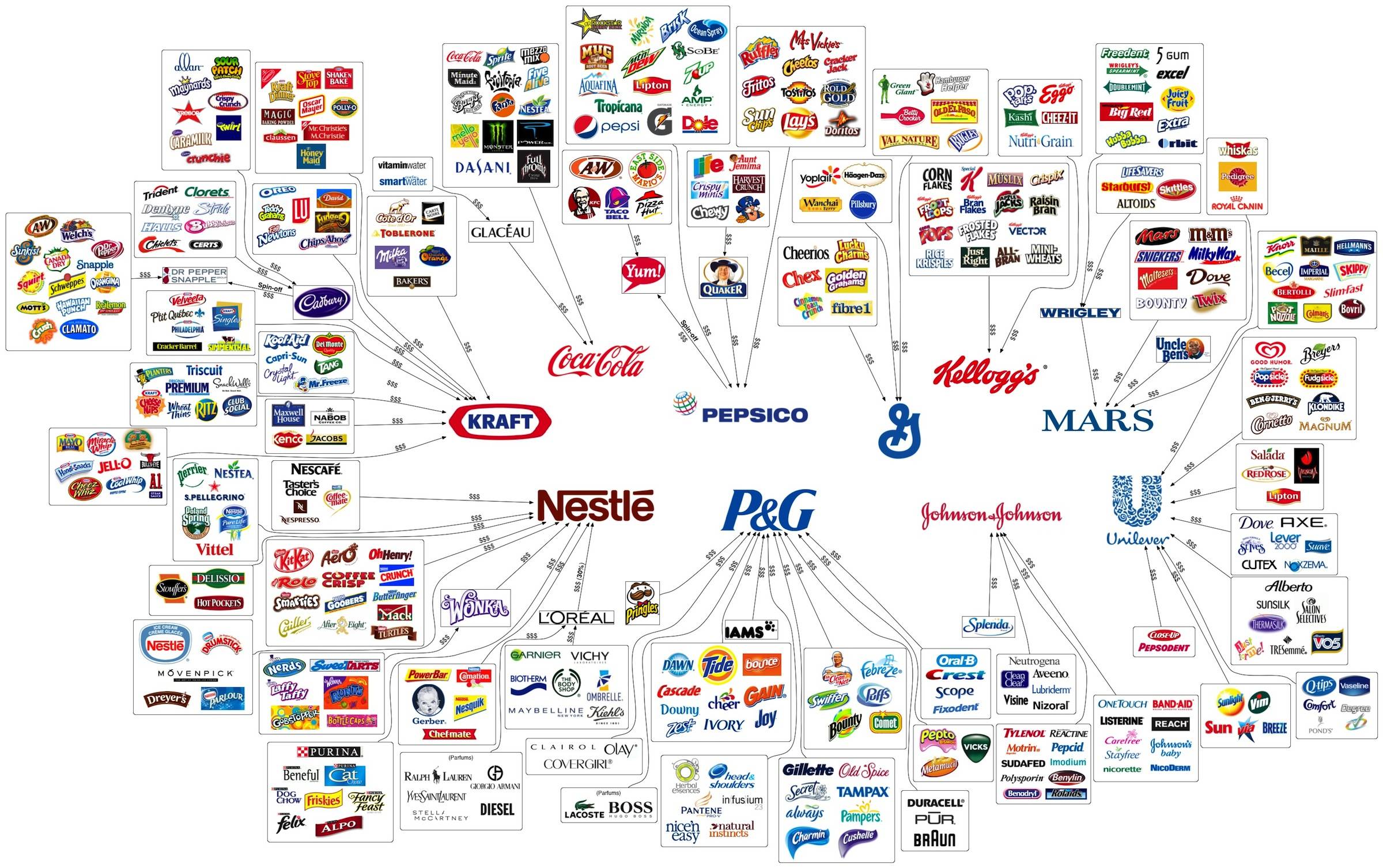
There has been massive consolidation within nearly every industry during the past 30 years. Even though the GDP has tripled since 1975, there are 18 percent fewer stocks traded today than there were 40 years ago. In consumer products and food, one chart shows how ten companies now control virtually everything we buy. True competition is vanishing from the consumer marketplace.
There is no one agency in the federal government responsible for the regulation of corporations. That responsibility is divided among various cabinet departments and independent agencies, each regulating different aspects of businesses. When created in 1913 to replace Theodore Roosevelt's Bureau of Corporations, part of Commerce Department, the Federal Trade Commission was supposed to enforce the Antitrust Laws. In fact it was created to enforce the Clayton Anti-Trust Act, which was adopted with it. For the most part the FTC has not played that role. Its focus in recent years primarily has been on consumer protection.  Various studies of the FTC's history have been highly critical.
The Justice Department today is the lead organization for enforcement of the antitrust laws, but antitrust actions are seldom taken. As a result, during the last 30 years there has been consolidation of industries on a scale not seen since the trust days of the late 19th and early 20th Centuries. Now, those consolidations occur on an international level creating business entities of such enormous scale that they are almost beyond regulation.
It is time to change the regulation of corporations by consolidating most regulation in one department, as Theodore Roosevelt did.
Regulation of corporations by the federal government is tricky because corporations do not get their authority to go into business from the federal government. They get their authority from the state where they file their charter. The federal government's authority over corporations comes primarily from the Commerce Clause, which gives the power to regulate commerce "among the states" to the federal government. For a long time, due to various Supreme Court decisions, it was difficult for the federal government to regulate businesses that were not engaged in interstate commerce. Later decisions of the Court opened up federal regulation of many areas, but with the current Court's conservative majority's recent attempts to limit the scope of the Commerce Clause, changes in federal regulation of business must be carefully constructed.
The federal government clearly has Constitutional power to regulate the actions of corporations and individuals when it comes to public health and safety, including the environment, and the effects of their actions on natural resource on public lands, including water supplies. The federal government has clear authority to prevent monopolies and constraints on free enterprise. There is plenty of Constitutional room to do what needs to be done.

New and Tougher Regulation

Substantially increased federal regulation of corporations is critically necessary to the survival of the American democratic republic. That includes restrictions on the roles corporations can play in government. Conflict-of-interest and full disclosure requirements must be imposed on both corporations doing business with the government and with all government officials, including members of Congress. We are very close now to almost complete corporate control of America. All it might take to eliminate the word "almost" is the election of a conservative Republican President.
American corporations must be discouraged from moving operations out of the country, rather than encouraged, as they have been by trade deals and government policies. No more trade deals should be approved without much greater protections for American workers.
For companies that are not in financial distress, but simply are seeking ways to increase profits, the cost of closing plants to relocate functions outside the country should be increased substantially, so that it isn't profitable to do so. Relocating plants of successful companies from the United States to countries with lower-wage workers should be subject to various penalties, including excess profits taxes and long-term financial compensation to laid off workers and to the communities where the companies were located.
To reduce the attraction of moving jobs offshore, very high tariffs should be applied to any products made by those new foreign facilities that the company wants to import into the U.S., so that there is no financial benefit of employing slave labor, or workers at extremely low wages, in other countries in place of American workers.
It should become national economic and foreign policy that the United States will not permit any company operating in the U.S. to benefit from the employment of slave labor, or from severe exploitation of impoverished workers in other countries. This should apply to retailers such as Walmart and K-Mart/Sears that purchase a huge amount of products from China, some of which may have been manufactured in “labor” camps, prisons for political prisoners, or others the Chinese government wants restrained. China recently announced it planned to close the labor camps, but there still are huge manufacturing facilities in China that operate almost the same, with workers forced to work extraordinarily long hours at very low ages.
No retailer should be allowed to import products from other countries when the only distinction the product has versus American competitors is that it costs less because of significantly lower wages. Not only would such a policy benefit American industry, and improve the American economy, it would equally benefit the economies, and peoples, of many other countries.
Finally, there should be severe economic consequences to any American company that moves its headquarters offshore to avoid taxes, including restrictions on their ability to do business in the U.S. Equally, there should be rewards for companies to locate their headquarters in the U.S. and make themselves subject to U.S. taxes.
In his 2015 budget, President Obama proposed a new system of taxing the offshore profits of American corporations at lower rates that, if enacted, could generate hundreds of billions of dollars in new revenue over a period of time, and enable corporations to repatriate profits at lower cost. The odds that the Republican Congress will enact his proposal probably are not very good.

Conclusion

The history of capitalism shows that great abuses always have resulted from great concentrations of economic power, and there is no reason to believe they will not occur again, but now it could occur on a scale never before imagined. It is time for Congress to review government regulation of corporations with a goal of learning from them by consolidating regulation in one agency charged with increasing the scrutiny of antitrust behavior, and behavior that endangers the financial and political stability of the United States. Congress also should eliminate exemptions from regulations that the oil and gas industry have received, and should adopt the other regulations discussed above.
These changes are unlikely to happen so long as Republicans control Congress. The issue of the threat - and the effects - the real effects on us - of corporate dominance of government must become a political issue. The conflicts-of-interest of Republican members of Congress who gain financially from actions they take on behalf of wealthy corporations must be exposed. The exemptions from regulation are a scandal that never has gotten the attention and focus it should have. Fracking is a national danger and it must become a political issue. We need oil, but at what cost?
Democrats must step up. They must cut their ties to the multinationals and the big banks. They must stand up for the people. They must organize to defeat the Republicans, regain control of Congress and stop the corporate takeover of America.

---
[1] [1] See Gelter, Martn. “The Pension System and the Rise of Shareholder Primacy” June 7, 2012.http://papers.ssrn.com/sol3/papers.cfm?abstract_id=2079607 in which the author argues that the development of the 401-K is a prime cause of the conversion of “managerial capitalism” to “shareholder capitalism,” the changes of the focus of corporate management from its own interests to an almost exclusive focus on the interests of shareholders.
[2] For a comprehensive review of the failure of the IRS regulation to control executive compensation see, Steven Balsam. Taxes and Executive Compensation. Economic Policy Institute, Aug. 14, 2012. Briefing Paper #344.http://s1.epi.org/files/2012/BP344_Taxes_and_Executive_Compensation.pdf 

[4] Extensive information about ALEC athttp://www.alecexposed.org/wiki/ALEC_Exposed